Buy your home, or keep renting and invest the difference: the net worth of each path at your horizon, and the year buying catches up with renting.
Your situation
Selling costs, tax, insurance
%
Agent and surveys, as a % of value. 0 if you sell without an agent.
%
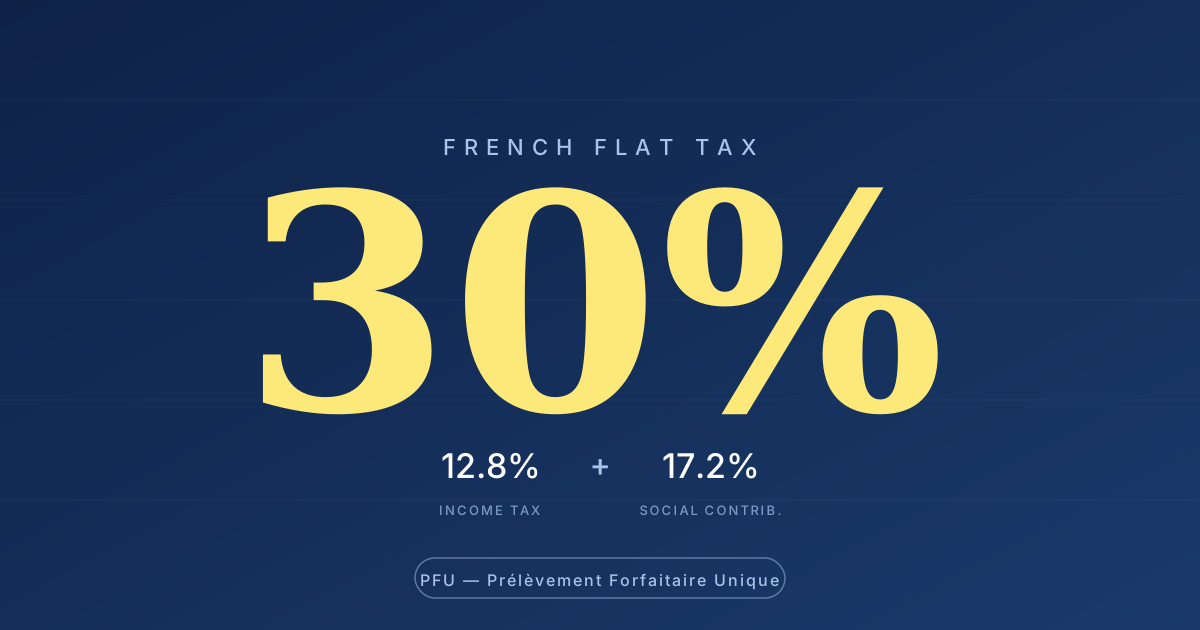
30% under the French flat tax. Use your own country's rate.
%
As a % of the amount borrowed, per year
€/yr
Per year, above what a tenant would pay
Your figures are never transmitted: the calculation runs on your device. Only anonymous audience measurement (page view, click) is recorded, with no figures at all.
Enter the property price and the rent to compare the two paths.
Net worth after 15 years
—
The net worth of each path at your horizon, on the same budget.
Buy
—
Net worth after 15 years
Rent and invest
—
Net worth after 15 years
The break-even yearThe first year the buyer's net worth equals or exceeds the renter's. Before it, purchase and selling costs still weigh.
The year buying catches up with renting, if it does.
A calculation under your assumptions, not advice — the method is set out in the FAQ.
Free, no credit card, no connection to your accounts.
The guide
Compare two net worths, not a mortgage payment and a rent
The question is badly framed when a mortgage payment is set against a rent. The owner repays capital they will get back; the renter pays for a service they will not. But the renter keeps the deposit, and often part of each month. The only fair comparison follows two households on the same budget: whatever one does not spend, it invests.
Buying starts with a handicap. Purchase costs, about 8% of the price for an older home in France, are lost at signing, and selling costs await at the exit. It takes years of repaid capital and, where it happens, rising prices to erase them. That is why the horizon matters as much as the price: over three years buying is rarely ahead; over twenty it often is.
Two figures decide almost everything, and neither is known in advance: the change in the property's price, and the return on the renter's investments. The tool does not supply them; you type them. Move either by one point and watch the break-even year shift. It is the question raised in the article on wealth at 30: compare, figures in hand.
invest the difference
Both households spend the same amount each month. Whoever spends less invests the gap: the renter while the mortgage costs more than the rent, the owner afterwards.
break-even year
The first year the buyer's net worth equals or exceeds the renter's. Before it, purchase and selling costs still weigh.
purchase costs
Mostly transfer taxes. In France, about 8% of the price for an older home and 2 to 3% for a new build. They are lost at signing.
main residence
In France, the gain on selling your main residence is exempt from income tax and social levies, so the tool applies no tax to the home. Check the rule in your own country.
How to read the result
1
Same budget, two uses
Each month both households spend the same amount. The owner pays the mortgage and costs, the renter pays rent, and whoever spends less invests the gap. Without this rule buying would always win: forced saving would be compared with no saving at all.
2
Net worth, not the payment
The headline figure is what each household would have if it sold everything at the horizon: the home minus selling costs and the remaining loan, the investments minus tax on their gains.
3
The break-even year
It is the first year buying catches up with renting. If you expect to move before it, buying costs you; if you stay beyond it, it pays, under your assumptions.
4
Your assumptions, not ours
A price rising 2% a year or standing still, investments at 2% or 5%: the gap between these scenarios often exceeds the gap between the two paths. Try several before settling on a figure.
This calculation does not say whether to buy. It cannot see what matters as much as money: the stability of a home of your own, the freedom to leave, the size of the family in ten years. It measures the financial side, under your assumptions. See also [what the flat tax really takes](flatTax) and what inflation does to wealth.
A decision is weighed across your whole net worth
Renting or buying shapes your net worth for twenty years. Patrice tracks your property, loans and savings, and projects what a purchase changes over ten years, with your own figures. The account is free; the demo shows the app with sample data.
No. The calculation runs entirely in your browser, on your device: no figure is sent to a server, and nothing is kept after you close the tab — except, on this device only, the values you entered, so that switching language does not empty the form.
Because it is the only fair comparison. On signing day the buyer pays the deposit: the renter invests the same amount. Then each month the owner pays the mortgage, insurance, property tax, charges and upkeep; the renter pays rent and invests the gap. Once the mortgage is repaid, or if rent is higher from the start, the owner invests the gap instead. Both households therefore spend exactly the same amount.
In France, no: the gain on selling your main residence is exempt from income tax and social levies, so the tool applies no tax to the home. The rule differs elsewhere; check your own country's. Gains on the renter's investments are taxed at the rate you choose.
It is an assumption, and it is yours. A savings account, a capital-guaranteed fund or a share portfolio have neither the same expected return nor the same risk. Comparing a home with a riskier investment means comparing two different risks: try several rates. Patrice recommends no investment.
It is the French flat tax on capital income: 12.8% income tax plus 17.2% social levies on the gains of a securities account. Use the rate of your own country or account. Tax is charged on gains only, as if the investments were sold on the date shown.
Because all three track the cost of housing over the long run. The tool applies the same rate of increase to rent, property tax, charges and insurance. Maintenance is a percentage of the home's value, so it follows the price change you entered.
Home-buying subsidies; refinancing or early repayment of the mortgage; major works; moving before the horizon; and inflation, since all amounts are in nominal euros on both sides. Nor does it say anything about what cannot be counted: stability, the freedom to leave.
No. Patrice measures and visualises; it does not advise. The result describes what two net worths become under the assumptions you entered; it changes as soon as they do, and none of them is a forecast.
 wealth management