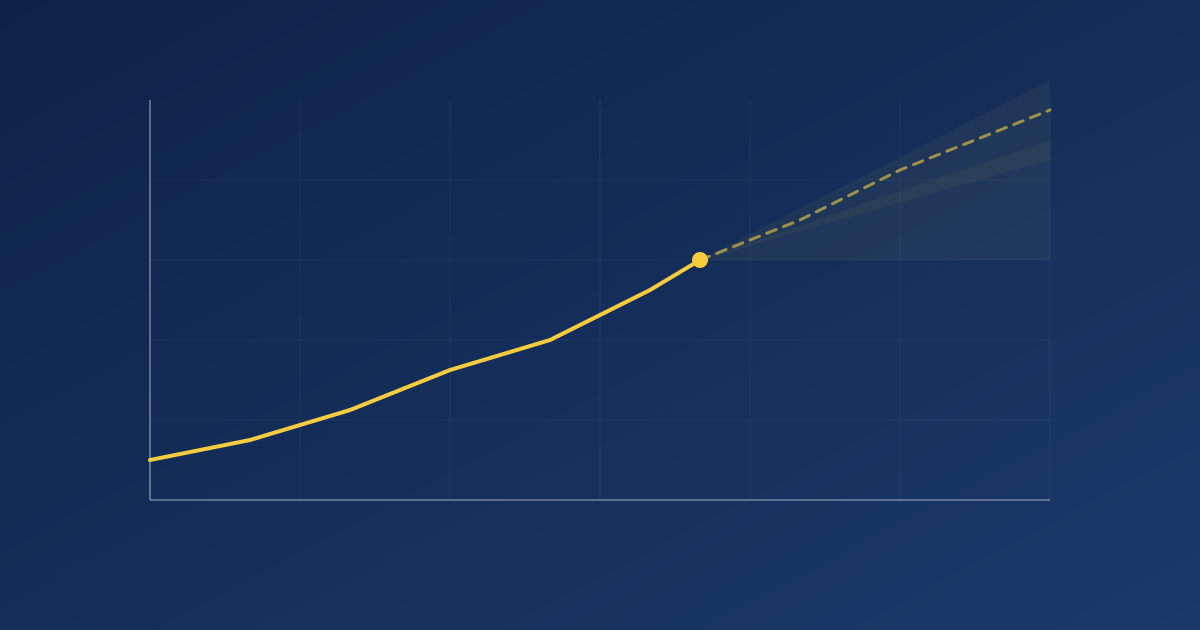
The capital your savings will have built, and above all what it pays each month — living off the interest, drawing the capital down, or at constant purchasing power. Every amount also in today's euros.
Your assumptionsReturns, inflation, end age. The suggested values are cautious — adjust them.
%
An assumption, not a promise — 4 to 6 % for a diversified allocation
%
More cautious: you de-risk as the date approaches
years
Not your life expectancy: stopping there is a coin flip on outliving it
%
2 % is the European Central Bank's target
Everything is computed in your browser. Your amounts are never sent, stored or shared.
Enter what you set aside to see your income.
Capital at retirement
—
The capital your savings will have built by the day you retire.
You will have paid in
—
Returns add
—
What that capital pays each month
Three ways to live off it. They do not pay the same, and they do not leave the same behind.
Living off the interest—
You never touch the capital: the income never stops, and the capital passes on in full. It is the only option that settles the risk of living a long time.a month
Drawing the capital down—
The capital is emptied at the age you set. The income is far higher — but it loses purchasing power every year, and if you outlive that age, nothing is left.a month
At constant purchasing power—
The capital is emptied at the same age, but the income tracks inflation: the last payment buys as much as the first. It is the only one of the three that keeps the promise you think you are buying.a month
Personal savings only, excluding state and occupational pensions. Return and inflation are assumptions you enter.
Free, no credit card. Your data stays yours.
The guide
A capital is not an answer
Ask any retirement calculator what you will have accumulated and it returns a six-figure number. That number means nothing until you know two things: how much it pays a month, and what that month will actually buy.
Start with the second, because it is the harsher one. At 2 % inflation — the central bank's target, so the low assumption — capital built over twenty-four years loses 38 % of its purchasing power on the way. The €400,000 on screen buys €249,000 of today's money. That is not a presentation detail: it is the difference between a comfortable retirement and a tight one. Which is why every amount on this page is given twice, and it is the same mechanism inflation applies to all of your wealth.
Then the first question: how much a month. There is not one answer but three, and the gap between them is wide. Living off the interest alone never touches the capital: the income is the lowest, but it never stops and your children inherit all of it. Drawing the capital down empties it at an age you set: the income can double, and nothing is left — not for you if you outlive that age, and not for anyone after.
The third is the one almost nobody computes. A flat €1,800 a month for thirty years does not buy the same in year one and year thirty: at 2 % inflation it has lost 45 % along the way. The indexed income starts lower and grows each year, so the last payment buys as much as the first. It is the only one of the three that keeps the promise you think you are buying when you read «€1,800 a month».
One last word on the end age. The reflex is to enter your life expectancy — and that is a mistake, because a life expectancy is an average: half of people live beyond it. Planning to 95 costs a lower income; planning to 82 and living to 92 costs ten years with no capital. Prudence is paid for once; imprudence is paid at the age when nothing can be done about it.
Plan through to
The age your income must last to. Setting it at your life expectancy is a coin flip on your old age: half of people live beyond it, and find themselves with no capital. Hence the 95 suggested by default.
Today's euros
What a future sum will be worth, expressed in what it buys now. At 2 % inflation, €1,000 in twenty-four years buys €621 — the only figure you can compare with your current budget.
Withdrawal rate
The share of capital taken out each year. Living off the interest alone means withdrawing exactly the return; drawing the capital down means withdrawing more, and exhausting it in the end.
Sequence of returns
The order in which good and bad years arrive. Two retirements with the same average return end very differently if one takes its fall early: you then withdraw from a reduced capital, and it never recovers.
The four figures to gather
1
What you already have
PER, life insurance, PEA, savings accounts: everything earmarked for retirement, across every wrapper. It is half the result — the starting capital compounds for the whole period.
2
What you pay in
The monthly amount, standing orders included. Over twenty years, an extra €100 a month weighs heavily; over five, far less. The horizon does the work, not the amount.
3
Your return assumptions
Two rates, not one: the saving phase, and retirement — more cautious, because you de-risk as the date approaches. Stay modest: one point too many changes everything, and nobody guarantees it.
4
The age to plan through to
Not your life expectancy. Take it wide: it is the only variable whose error is discovered too late to correct.
This calculator covers your PERSONAL savings only: state and occupational pensions add to it, and your career statement estimates those far better than we could. It also ignores the tax on withdrawals, which depends on the wrapper — precisely the question settled by the PER against the PEA. And it assumes a constant return, which markets are not: to test a path rather than an average, project how your wealth evolves, then [take stock of what you have today](netWorth).
A projection is only worth its figures
This calculator starts from two amounts typed by hand. Patrice keeps your actual savings current — every holding, every account — and projects from what you really have, not from what you remember.
No. It covers only your personal savings — PER, life insurance, PEA, savings accounts. State and occupational pensions add to it, and your career statement on info-retraite.fr estimates those from your actual contribution quarters, which no general calculator can do. Add the two together for your full retirement income.
Because a life expectancy is an average, and half of people live beyond it. Building your plan on it is a coin flip on your old age: if you win, you spend your last years with no capital. Planning wide lowers the income by a few hundred euros; getting it wrong the other way costs whole years. This is also what the «living off the interest» option settles, since it never runs out.
The flat income pays the same amount every month throughout retirement. As prices rise, it buys less and less: at 2 % inflation over thirty years, the last payment buys 45 % less than the first. The indexed income starts lower but grows with inflation, so your standard of living does not move. Both empty the capital at the same age.
None is guaranteed, which is why the field is yours. For reference, a diversified allocation over long periods has sat between 4 and 6 % a year before inflation, a euro fund well below that. Lean towards the bottom of the range: an over-optimistic projection is only corrected by discovering, at sixty, that a third of the capital is missing.
No, and that is this calculator's honest limit. The order in which good and bad years arrive matters as much as their average: two retirements with the same average return end very differently if one takes its fall in the early years, because you then withdraw from a reduced capital and it never recovers. Treat the result as an order of magnitude, not a forecast.
No. The calculation runs entirely in your browser, in JavaScript: neither your age, nor your capital, nor your contributions leave your device. Nothing is sent to a server, nothing is stored, and closing the tab erases everything. There is no account to create and no address to leave.
 taxation